AI + Magic: The Gathering
Two projects, both finished. Eight Commander decks built around feelings instead of win rates, and a five-night campaign that taught two people who had never played Magic how to play Magic.
If you don't play Magic, this page will either convert you or confirm that you made the right choice avoiding it.
Build Decks by Vibes, Not by Meta
Here's what I hated about Commander once everything went online: everyone just searches "best Atraxa deck" or "top Korvold combo" and copies whatever has the highest win rate. The entire creative soul of the game got replaced by optimization spreadsheets. People stopped asking "what do I want this deck to feel like?" and started asking "what's the strongest version of this card?"
I wanted to flip that completely. Instead of starting with a commander or a strategy, I start with the experience.
The Process: Feelings First, Cards Second
Start with the vibe.
Not "I want to play Gruul aggro." Instead: "I want the moment where my friends realize I am a chaos goblin who cannot be reasoned with. I'm going to throw their carefully laid plans into absolute anarchy. They're going to want to kill me for it, but if they do, they trigger something terrible for everyone, so they have to sit there and take it." That's the prompt. The emotion, the table dynamic, the roleplay fantasy.
Let AI talk to AI.
There is an absurd amount of Commander content online: deck techs, EDHREC data, Reddit threads, YouTube primers, articles on synergies. Way more than any human could read. But AI can synthesize all of it. I give it the vibe, the power level I want, and let it work backwards through the entire universe of Commander content to find commanders, archetypes, and strategies that match the feeling, not just the win rate.
Generate 50 ideas. Pick 3. Refine.
Once the vibe is locked, AI can generate dozens of deck concepts. I pick the ones that make me laugh or get excited, then dial them in: "Make it a little more silly. Choose card art that's goofy and on-theme. Lean into the chaos angle." It keeps iterating until the deck feels right, not just plays right.
Copy-paste into proxies. Play for $50.
The final list gets exported proxy-ready. Every card runs about 50 cents, so a deck lands around $50 against the $150 I spent on the one deck I built the traditional way. Custom tokens are roughly $10 for ten and add more flavor per dollar than anything else in the hobby. I'm not trying to own expensive cards. I'm trying to be wildly creative at the table.
Play. Note. Iterate.
After a game, I take a quick note on my phone: "That was really fun, but I felt too vulnerable. Didn't have enough deterrence to keep people from swinging at me. I want to be a little more defensive without losing the chaos angle. What changes?" Then the deck evolves, I swap a few proxies, and it costs me a dollar. You don't have to read every card. You just have to know the vibes.
The whole AI-assisted build happened over about four days while Bailey was at a conference, which tells you everything you need to know about my ability to moderate a hyperfocus.
The part I didn't plan: the eight decks turned out to be a designed ecosystem. Every one answers a different question, and none of them overlap in either mechanical or emotional space. Politics, inevitability, pressure, and stories. I set out to build fun decks and accidentally built a set.
The best idea in the whole project: FUN / GO HARD / SPIKE
Most decks have one power level and a lot of unspoken assumptions around it. Mine have up to three, and each one has a physical double-sided card printed on cardstock that lives in the deck box. Flipping the card is an escalation. Pulling out the SPIKE card is a negotiation with the table.
The deck as designed. The vibe, unmodified.
Same identity, sharper. A tuned package swapped in.
A different game. Fast mana, real interaction, no mercy.
SPIKE isn't "more power." It's a different agreement. That reframe is the thing I'd carry into any game. Physical objects solve social ambiguity better than conversation does. Nobody has to guess how serious the table is when the answer is sitting face up next to the deck.
What I got wrong first: I blended GO HARD and SPIKE into one blurry tier, and I tried to give every deck all three modes. Both were mistakes. Some decks should not scale at all.
The Eight Decks
Each one started as a feeling and ended as a pile of 50-cent proxies. Two are on Moxfield. I got bored of transcribing after that, which is the most honest thing on this page.
Riders of Rohan
The LotR precon commander
The control deck. Built the old way, before any of this.
This is the "before" picture. One deck, roughly $150, assembled the traditional way by buying singles. It plays fine. It also cost three times what every deck after it cost, and it is the only one I did not design around a feeling.
The Social Grenade
Kardur, Doomscourge
Forced combat and table politics. Everyone attacks, nobody chose to, the table slowly realizes I did this.
The purest version of the chaos-goblin prompt. It does not scale up or down, because escalating it would ruin the joke.
Nazgûl
Lord of the Nazgûl
Wraith tribal, spells matter, late-game oppression. Nine ringwraiths and a growing sense of dread.
The Go Hard package is where Orcish Bowmasters, The One Ring, Cyclonic Rift, and a fast-mana suite live. They stay in the box unless the table asks for them.
Five-Color Slivers
The First Sliver
The don't-let-this-untap deck. Every sliver makes every other sliver worse for you.
The one deck where the threat assessment is obvious to everyone at the table by turn four, which is its own kind of fun.
The Shire
Frodo & Sam
Cozy food value that can turn genuinely scary. Binary. It is either a lovely time or a problem.
The sleeper. People do not respect it until the turn they should have.
Sauron Noob Stomp
Sauron, Lord of the Rings
Amass and reanimation. The cinematic late-game menace, with a sideboard Sauron for when it needs to be worse.
Named honestly. The Spike layer swaps in the second Sauron and turns a fun deck into a rude one.
View the list on Moxfield →Land Noms
Lord Windgrace
Symmetrical pain. Pox and Death Cloud, 40-plus lands, everyone suffers equally and I suffer least.
The ask-first deck. I do not put this on the table without telling the table what it does. Land destruction is a social contract issue before it is a strategy.
View the list on Moxfield →Blight Curse
Auntie Ool, Cursewretch
Political aristocrats. Negotiated suffering, attrition, drains that hit some players harder than others.
The only one still actively changing. Every game gives it a new idea.
The Sites I Actually Used
Building the lists is half the job. Getting them onto cardstock that feels right in a sleeve is the other half, and nobody writes about that part.
Moxfield
Deck hosting and the source of truthMoved all nine lists off Google Docs onto this. One-click export to a proxy-ready text block is the whole reason.
MPCFill / MakePlayingCards
PrintingThe gold standard for card-stock feel. S30 and S33 stock. This is where every custom card order goes.
PrintingProxies
PrintingS33 German black core with authentic corner cuts. Good when the corner tell matters.
PrintMTG
PrintingHighest image resolution and the easiest workflow. Not an editor though, so text has to be baked into the image first.
Archidekt
Deck conceptualizingBetter than Moxfield for grouping cards into visual packages when a deck is still forming.
Scryfall + EDHREC
Card lookup and validationWhere every AI suggestion goes to get checked. Non-negotiable step.
DeckCheck.co
Power level analysisAn MTG-specific analyzer for power level and mana base. Useful sanity check before a deck hits the table.
ManaBox
Collection trackingPhone scanning for physical cards. Still the weakest link in the whole workflow, and not their fault.
The thing I learned about proxy quality: physical feel and corner-cut accuracy matter more than image resolution. Blue core versus black core stock, and the corner radius, are what people notice. A gorgeous 1200 dpi print on the wrong stock still feels like a printout.
Three Things That Went Badly
1. Long threads hallucinate card lists
This was the single biggest problem in the entire project. Long-running chat threads would quietly start adding cards that were never in the list. Not wrong recommendations, invented inventory. The root cause is that there were no checkpoints. AI is incredible at generating and ideating and genuinely bad at being the system of record for a complex, evolving project. You need external checkpoints, and I did not have them. Persistent files would have solved it, which is most of why I work the way I do now.
2. Six hundred proxies arrived in one unsorted brick
I batch-ordered roughly 600 cards for six decks at once to save on shipping. They arrived with nothing indicating which card belonged to which deck, and the decks share heavy color and theme overlap. I printed the lists and hand-sorted all 600 by eye. About ten hours of work that a single line in the order file would have prevented. It still wasn't perfect at the end, because some of the cards I was sorting against were the hallucinated ones from problem number one.
3. There is no good physical-to-digital bridge
By far the largest friction point, and the one I still have not solved. There is no way to scan a real collection into a digital list that is worth the time it takes. This is a genuine gap in the hobby's tooling, not a preference of mine.
The prompt that changed everything
Most of my prompts were about cards. The one that mattered was about experience: "Explain how this feels to play." The output stopped being a list and started being a description of a game. That's when I could tell whether a deck was worth building.
The other one was a consolidation prompt I started calling State of the System, which forced everything scattered across a dozen threads into one current picture. That's the moment AI stopped being a card recommender and became a system designer.
The Blighted Grove: Teaching My Wife to Play Magic
My wife Bailey and her friend Divya had never played Magic. They've played plenty of board games (Bailey's favorite game in the world is Everdell; we own something like six versions of it, all with tiny woodland creatures collecting tiny woodland resources). They love cute animals. They do not love reading 100 unique cards with eight lines of rules text each.
Here's the problem I keep seeing: people teach new players by throwing them into Commander. A hundred unique cards, three opponents with their own hundred, and a format that is called casual but is one of the most complex ways to play. Not understanding half the rules while everyone else combos off is the worst possible first experience.
So I built a five-night campaign instead. Bloomburrow starter kits as the base, custom proxy upgrades layered in over the course of the campaign, and a story where the mechanics are the plot. Bailey and Divya became the Embers of the Veil, defending their village from a spreading blight. Two heroes against me running the Blight, 2v1, so they could talk strategy together instead of feeling lost alone.
Five Nights
Each night has a win condition that teaches one thing. Nobody ever read a rules explanation. Every card upgrade arrived in a physical envelope opened at the table, because the dopamine hit is half the teaching.
The Hearth & The Horde
Defend the village gates, 20 health, through turn eight. Teaches threat assessment and reach versus flying without ever using those words.
The Veiled Reach
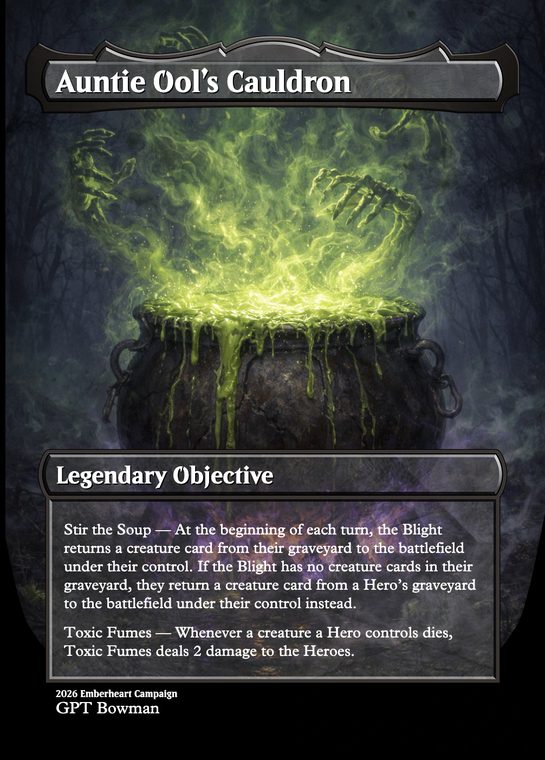
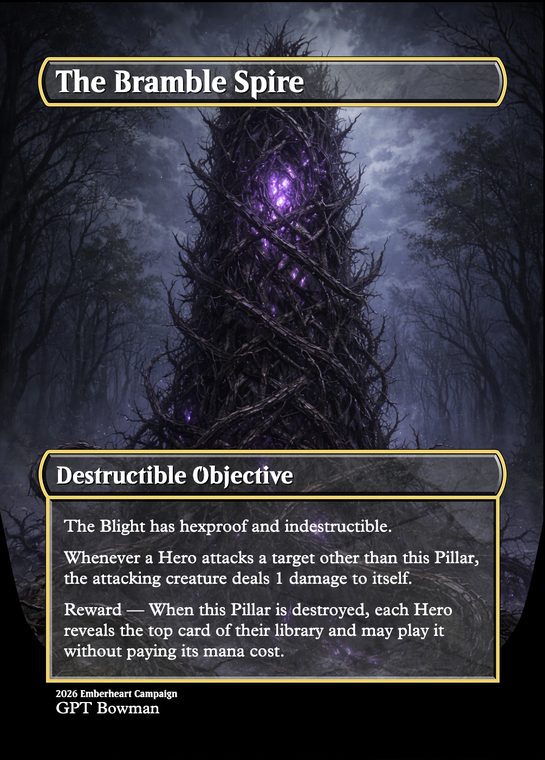
Destroy three Blight Spires, each with a different ability, before you can touch the boss. Teaches prioritization. You cannot just attack the scary thing.
The Awakening
Protect the Sapling while defeating Tergrid. Split attention, race conditions, and the night with The Choice moment in it.
The Crossing into Shadowmoor
Blight tokens punish every discard and every sacrifice. Complex boards, and the first night where losing pieces is part of the plan rather than a mistake.
The Boiling Point
Heroic sacrifice as a strategy. A creature dying while blocking fuels a Bloom Token that nukes the Cauldron. The finale, and the one they lost.
How it actually ended
They lost Scenario 5. And the reason is the funniest thing I learned running this whole thing: they were scared to attack. Both of them had wide, genuinely threatening boards, more than enough to close it out, and they kept holding creatures back because swinging felt dangerous.
Five nights of teaching mechanics, and the instinct they were missing was not a mechanic. It was permission. New players need to be told that attacking is allowed, that a board full of creatures standing still is not safety, and that the scary feeling is the game working. I'd design that into night two next time instead of hoping it emerges.
Then the actual win: we rolled straight into four-player Commander with real decks, because they had the fundamentals. We're playing more, and they want to build and edit their own decks now. That was never a stated goal of the campaign and it's a far better outcome than finishing it.
The Custom Cards
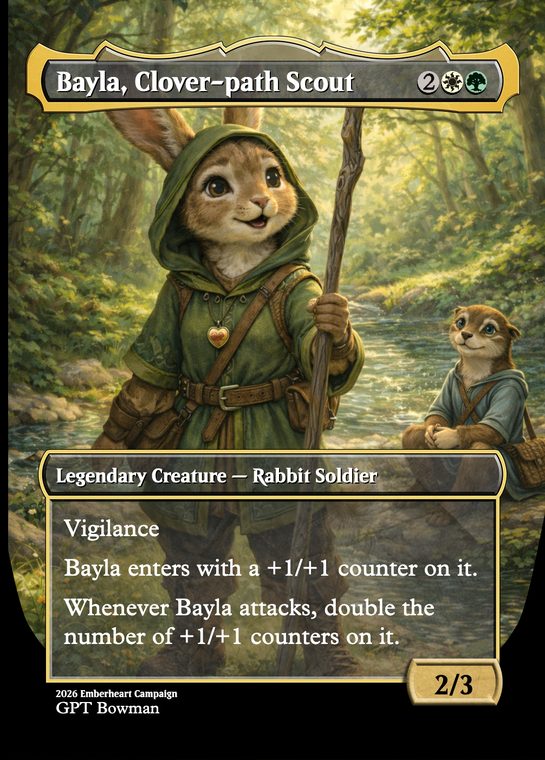
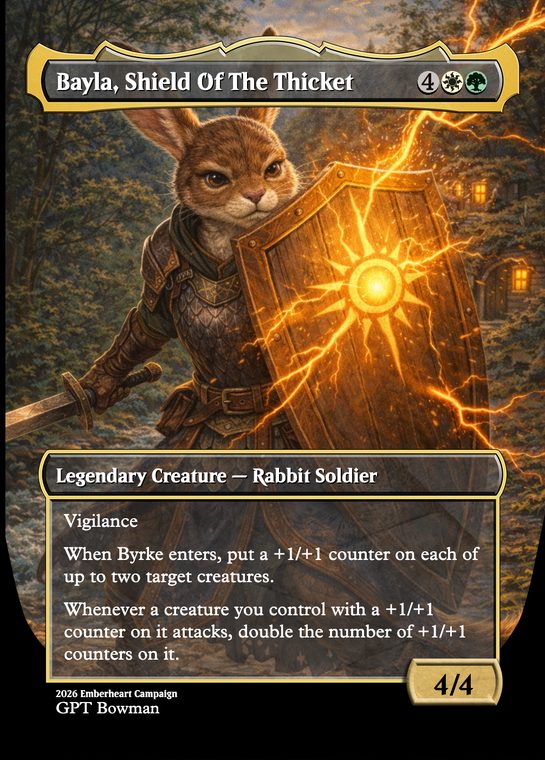
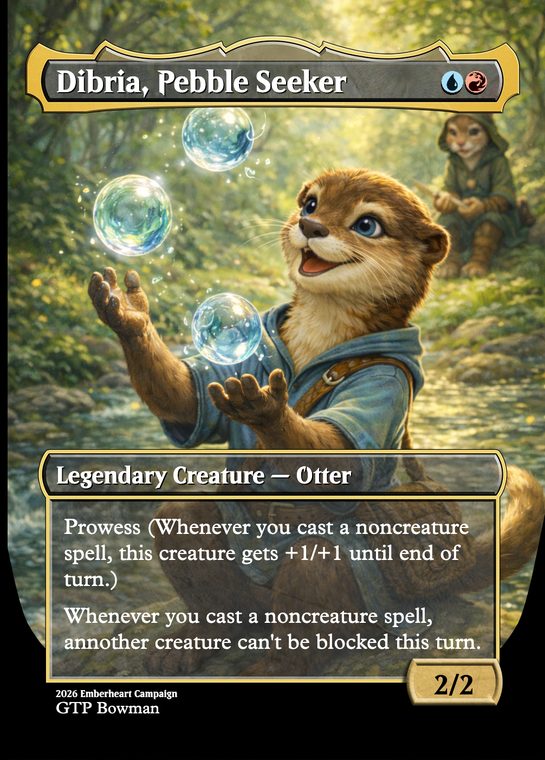
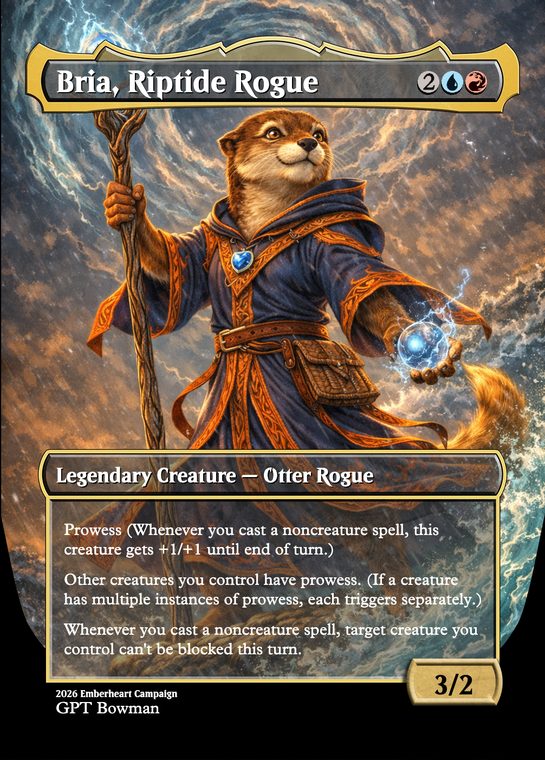
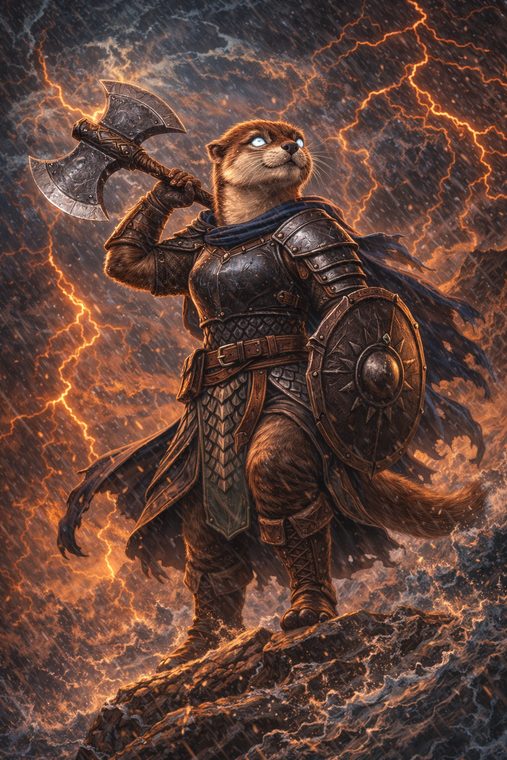
Bailey is a rabbit. Divya is an otter. Both level up over the course of the campaign, and both cards have their names on them. Printed on real cardstock through MakePlayingCards, set symbol and all. The cards stopped being gameplay components about ten minutes in and became artifacts of a night with friends.
The Art That Didn't Work
My folder of rejects is bigger than my folder of finals, and the rejects are more useful. These are the real filenames I saved them under, because I was not expecting anyone else to read them.
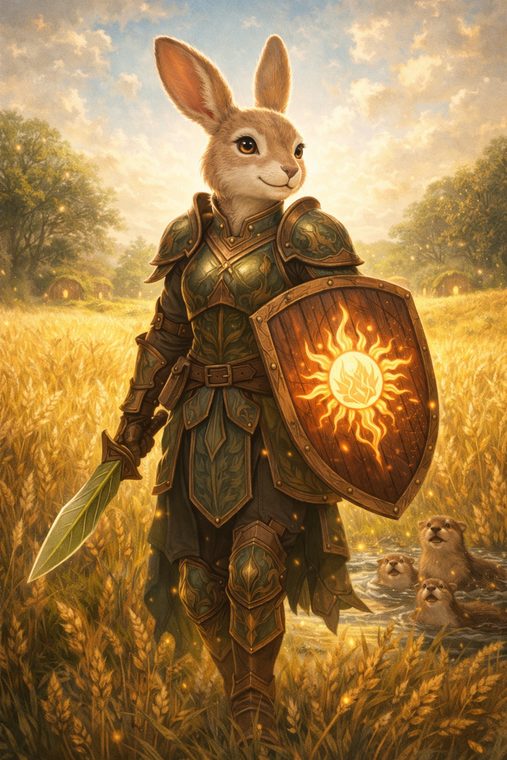
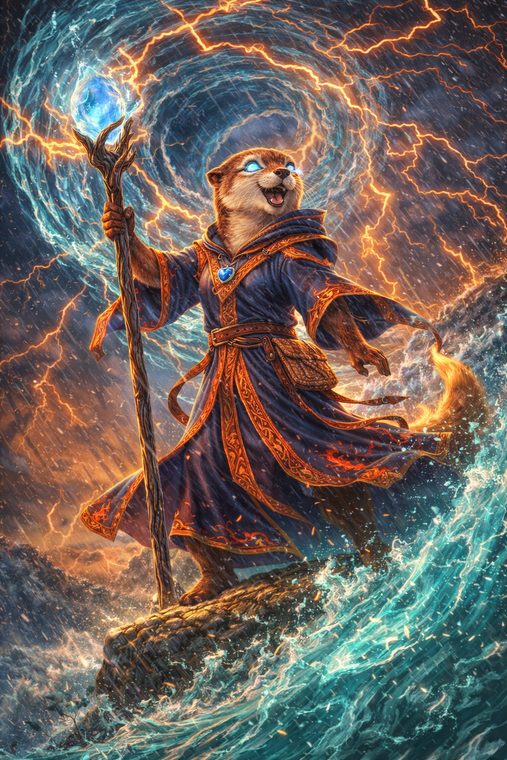

The lesson buried in these: the miss is almost never the model's fault. Every one of them is me failing to say which dial I wanted moved. "Make her more human" and "make her less of a rabbit" produce completely different pictures, and I did not know that until I had a folder full of rabbits.
The Rider of Rohan Problem
This one is from the Rohan deck, not the campaign, but it's the best story in the whole project. It started as a generic Lord of the Rings horse rider token. Perfectly good art. Completely forgettable. So I put my own face on it. Then I got bored again and made six expressions, each one worse than the last.
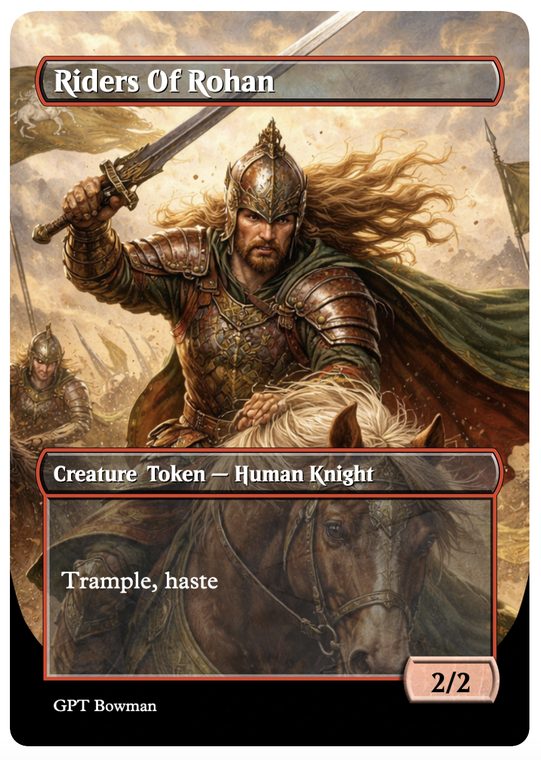
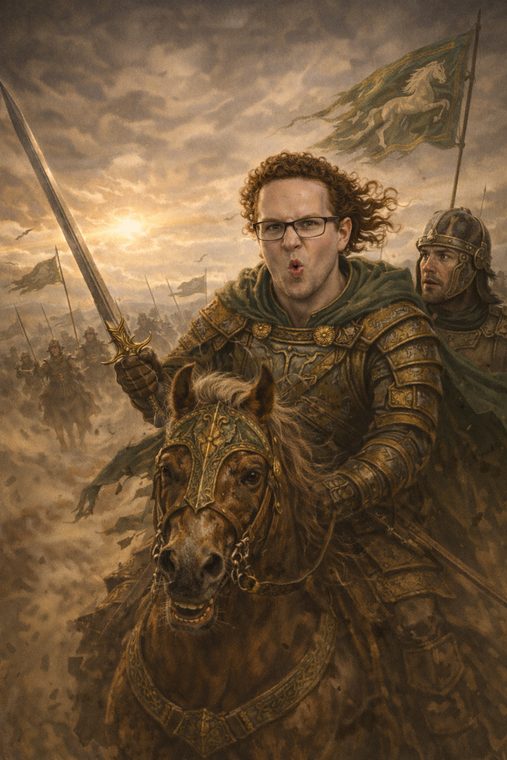
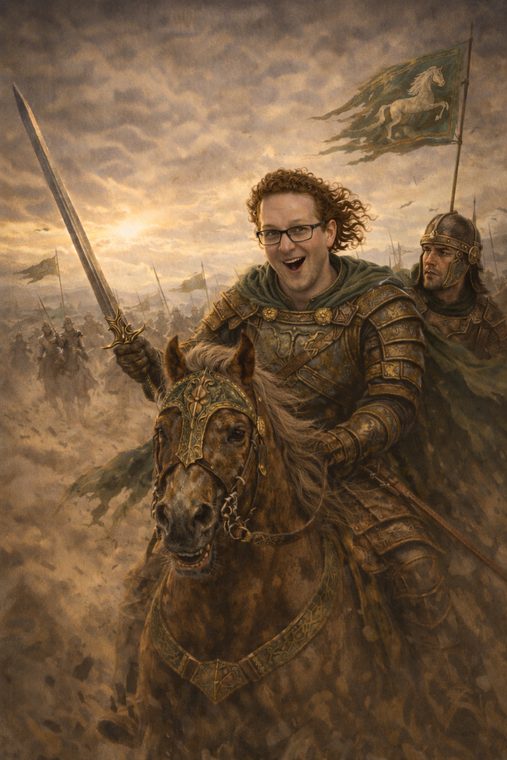
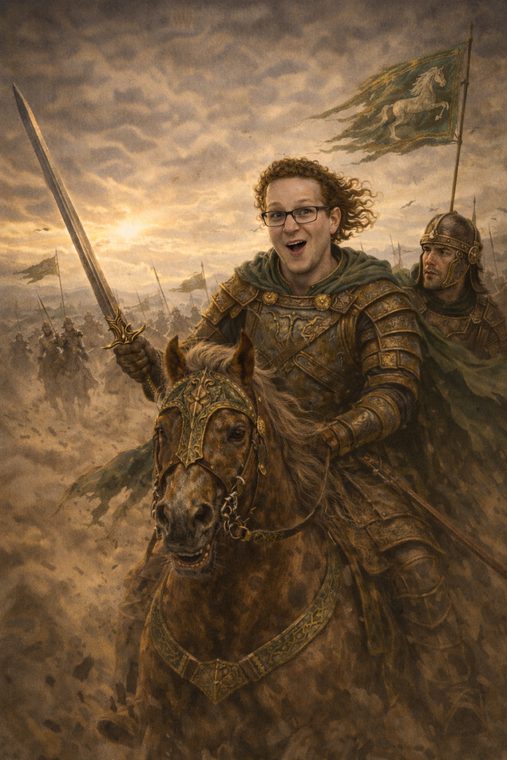
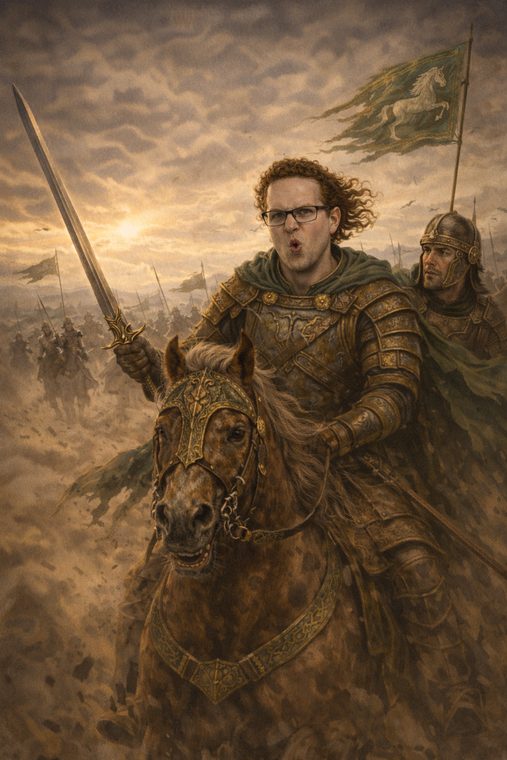
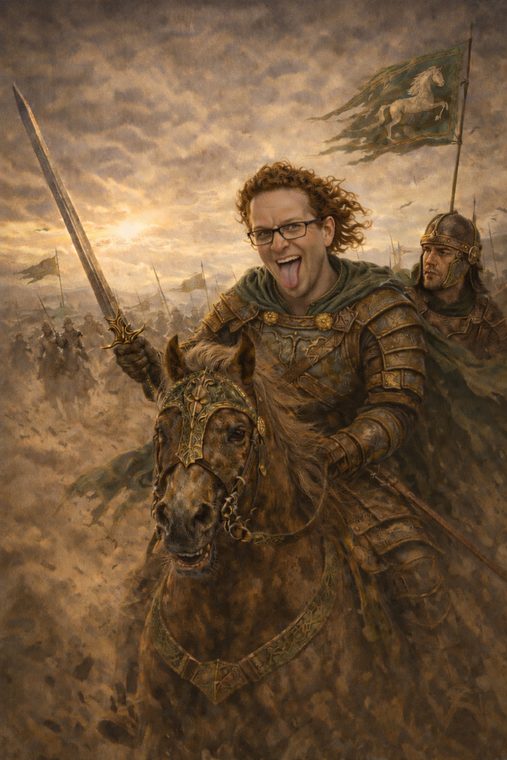
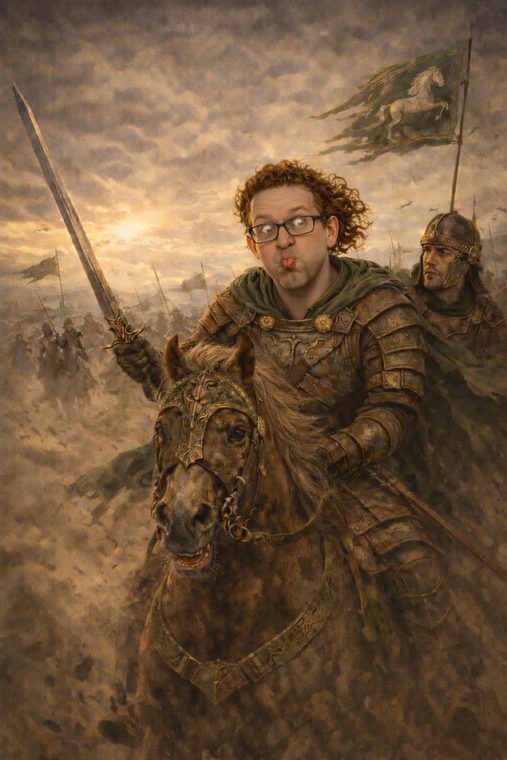
The deck makes more of these every turn. People think it's hilarious the first time. By the third time they're saying "what the hell, I can't believe you did this."
The point isn't "AI generated this for me." It's: started generic, got bored, made it personal, made it ridiculous, made it mine. That's the loop, and it's available to anyone with a reference photo and no shame.
What I'd Change Next Time
Cut the monoliths to one ability each
Three Blight Spires with three abilities each was too much text for new players to track. Visual differences should carry the load that rules text was carrying.
One trigger, one effect on the Cauldron
The Cauldron had a layered effect that took longer to explain than it added. If a card can't be read once and remembered, it's too much for night five, let alone night one.
Teach attacking earlier
See above. The finale was lost to hesitation, not to a rules gap.
Proofread the print file
One missing letter, 600 cards, flat shipping I'd already paid. "Bria" lives on my table until the next batch.
Want to run this yourself?
Total cost was about $100 in proxied cards and sleeves. I'm packaging up the five scenario guides, the progressive deck lists for both players, the Blight decks, the custom card templates, and the proxy guide so anyone can run it for a partner or friend who's curious about Magic and intimidated by the complexity.
Not posted yet. If you want it when it's ready, email me and I'll send it over.
Why AI Is Perfect for This
Magic: The Gathering has over 27,000 unique cards. Commander alone has thousands of viable strategies. The amount of content, data, deck techs, articles, and Reddit threads about this game is genuinely staggering. No human can process all of it.
But AI can. And when you point it at all that data with a prompt like "I want my friends to be laughing hysterically while I play a deck themed around woodland creatures committing crimes," it synthesizes everything and gives you options you'd never find by searching "best green/black deck." It's not replacing the creativity. It's supercharging it.
Same thing with the campaign. I described the experience I wanted Bailey and Divya to have, the games they already love, what overwhelms new players, and what makes Magic magical. The design that came back was progressive and story-first. I couldn't have built it that fast alone, and honestly, structuring it as a campaign might never have occurred to me.
The catch, and it's the same one from the deckbuilding project: AI is excellent at generating and terrible at remembering. Every good thing on this page came out of a loop where I generated fast and checked everything against Scryfall, a printed list, or a file on disk. The checking is not overhead. The checking is the work.
Both projects finished. Last updated September 2026.